

Biogas
The best use of your
biogas depends on
how much of its
heat your site
puts to work.
Every biogas plant comes back to the same question: what is the most efficient use of the gas it produces? It can be burned in a CHP engine on site, upgraded to biomethane, or split between the two. For UK operators the question has become pressing, as Renewables Obligation support starts to expire from 2027 and Feed-in Tariff payments run out over the same decade.
The answer depends on how the site uses energy. Four factors decide it: on-site heat and electricity demand, biogas flow, distance to a gas grid injection point, and the condition of the CHP engine. Plants that already put most of their recovered heat to work are usually best placed, whichever route they choose. Plants that run for electricity alone and dump the heat face a harder decision.
Most UK biogas CHP plants were financed on the back of support schemes that paid for renewable electricity. Those schemes are now running out, and the government has confirmed they will not be replaced.
Renewables Obligation (RO). It closed to new capacity in 2017. Support for existing plants starts to expire from 2027, and each plant reaches the end of its support period at a different date up to 2037. In September 2026 the Minister of State for Energy, Michael Shanks, confirmed that there will be no successor scheme for small-scale generators, anaerobic digestion included.
Feed-in Tariffs (FiT). They were introduced in 2010 for smaller installations and closed to new applications in April 2019. Tariffs were granted for 20 years, so payments run out over the same decade.
Renewable Heat Incentive (RHI). It paid for heat rather than electricity, including useful heat recovered from biogas CHP, as well as for biomethane injected into the grid. It closed to new applicants in March 2021.
The scale is significant. In late 2024 the Anaerobic Digestion and Bioresources Association (ADBA) estimated that more than 160 plants would reach the end of support within five years, and over 400 in the five years after that. ADBA also reported that some operators had already closed rather than pay for a new CHP engine or a digester refurbishment.
The only scheme open today is the Green Gas Support Scheme (GGSS), which pays for biomethane injected into the gas grid in Great Britain. Applications close on 31 March 2028, and the government has announced an extension of the commissioning deadline to 31 March 2030. Conversions are excluded, because equipment that has already produced biogas is not eligible. The government confirmed this position in January 2024 and said it would consider CHP conversions in a future biomethane policy framework (2028-2030).
For an operator, the practical consequence is that every route has to be judged on the plant’s own performance. The heat a site uses replaces fuel it would otherwise buy, and that saving does not expire with a tariff. A plant that ran for electricity alone, with its heat going to a dry cooler, is far more exposed.
Biogas and biomethane come from the same digester. The difference is what happens to the gas afterwards, and where its energy ends up being used.
Biogas is the raw gas from anaerobic digestion: typically 50–70% methane, with the rest mostly carbon dioxide plus water vapour, hydrogen sulphide and other trace compounds. After cleaning, it can fuel a CHP engine on site. The engine turns it into electricity and heat in the same place, and the overall efficiency depends on how much of that heat the site actually uses. With the heat put to work, a biogas CHP plant converts more than 85% of the gas’s energy into something useful. With the heat dumped, most of that advantage is lost.
Biomethane is biogas that has been through upgrading. The upgrading unit separates the carbon dioxide and the remaining impurities until the gas reaches a methane content above 95%, comparable to natural gas. The energy stays in gas form and leaves the site in one of two ways:
Upgrading also has its own costs. The unit uses electricity, the digester still needs heat to keep the biology running, and any methane that escapes with the separated CO₂ is a loss of energy and an emission. How much methane the unit recovers is one of the first figures to check when comparing upgrading systems. MTM upgrading units recover more than 99.6% of it.
So the choice between the two is a choice about where the energy is most useful: on the site, as electricity and heat, or off the site, as gas. For the full picture of how biogas is produced and treated before either route, see our guide to how biogas works.
An existing plant has three realistic options. They differ in what happens to the engine, where the revenue comes from, and how much of the gas’s energy ends up being used:
Keep the CHP running
This route needs the least new investment and no gas grid connection. Revenue comes from the electricity. The share used on site replaces power the plant would otherwise buy, and the surplus is exported under a supplier export tariff or a power purchase agreement. The digester keeps getting its heat from the engine’s cooling circuit and exhaust, as it does today.
The weak point is the engine. After ten years or more of near-continuous running, it is often due a major overhaul or a replacement, and that is the expense that has already pushed some UK operators to close. A retrofit can extend the life of the existing unit and bring its controls and monitoring up to date.
Whether that is worth doing depends on how much of the plant’s output the site uses itself. A site that consumes most of its heat and power keeps a value that no tariff gives or takes away. A site that exports almost everything is selling electricity at whatever the market pays.
Convert fully to biomethane
In a full conversion, all the biogas goes to an upgrading unit and the CHP engine is decommissioned or sold. Revenue comes from the gas: biomethane sold into the grid, with the certificates that document its renewable origin, or supplied as vehicle fuel.
It is usually the route with the highest investment. It needs an upgrading unit, compression and, for grid injection, a connection that can become the largest cost of the project if the plant is far from the network.
It also creates a problem the CHP used to solve at no extra cost. The digester still needs heat, and that heat now has to come from a boiler burning part of the gas or from a heat pump.
Full conversion suits plants with a high and steady biogas flow, a gas network nearby, and little on-site demand for heat or electricity.
Derate the CHP and upgrade the rest
Derating means reducing the rated output of the CHP unit, or replacing it with a smaller one, so that it matches the site’s own demand. That demand includes the digester’s heat, the farm or process loads, and the electricity the upgrading unit consumes. Whatever the site does not need goes to upgrading.
This route gives each use the gas it handles best. The engine runs close to full load against a demand that is always there, so its recovered heat is used rather than dumped. The digester keeps its heat from the engine, and the upgrading unit takes the surplus.
The investment usually sits between the other two routes, because the upgrading unit is sized for the surplus flow rather than the whole plant. The biomethane still needs a way off the site, through the grid or as vehicle fuel.
MTM Energia offers retrofitting and derating for existing agricultural CHP plants whose owners want to move into biomethane production, with upgrading units from 50 Sm³/h.
No single factor settles the choice, but four of them, read together, usually point clearly to one route.
1. How much heat and power the site uses
The first question is how much of the plant’s energy the site itself consumes, and above all how much of the recovered heat is actually used.
A digester needs heat all year to keep the biology at its working temperature, typically between 35°C and 55°C depending on the process. A CHP engine supplies that heat as a by-product. Retire the engine and the heat has to come from somewhere else, usually a boiler burning part of the gas, or a heat pump drawing electricity. Either way, energy the CHP was recovering now has to be produced on purpose.
So the more heat the site uses (digester, farm buildings, drying, process loads), the stronger the case for keeping a CHP unit, either at full size or derated. The weaker the heat use, the stronger the case for upgrading. A plant that runs for electricity and sends most of its heat to a dry cooler is already wasting a large share of its gas, and conversion may recover more of it.
The right starting point is measured data on heat use across a full year, not estimates.
2. How much biogas the plant produces
Upgrading only makes sense above a minimum flow, and the economics improve with scale.
As a rough guide, a 500 kWe biogas engine burns in the order of 200 to 250 Sm³/h of biogas, depending on methane content and engine efficiency. Upgrading units cover a wide range: ours run from 50 to 1,000 Sm³/h. But the cost per unit of biomethane falls as the unit gets bigger, so smaller plants often struggle to justify full conversion on their own. UK studies have looked at grouping neighbouring sites around a shared upgrading and injection point for this reason.
Flow over time matters as much as flow today. A farm with stable livestock numbers produces predictably. A closed landfill produces less gas every year.
Derating changes the arithmetic too. The surplus left after the CHP takes its share has to be large enough to justify the upgrading unit.
3. How far the plant is from the gas grid
Distance to a suitable injection point can decide the case on its own. A long pipeline, or a connection to a part of the network that cannot absorb the gas all year round, can cost more than the upgrading unit. In its 2024 review of the Green Gas Support Scheme, the UK government noted that many existing CHP sites are unlikely to be located near injection points.
In Great Britain there is a further operating cost: biomethane injected into the grid usually has propane added to match the calorific value of the network gas.
Where the grid is out of reach, the alternatives are vehicle fuel, compressed or liquefied, or keeping the energy on site with CHP.
4. The condition of the engine and the digester
The end of support often coincides with a worn engine, and that combination is what has pushed some UK operators to close. ADBA has reported plants shutting down because their owners could not justify a new CHP unit or a digester refurbishment.
A major overhaul that is coming due is the natural moment to choose a route, because the money is about to be spent anyway. The choice is no longer between overhauling the existing engine and walking away. It can be a smaller engine sized to what the site needs, with the rest of the gas upgraded.
We have done this resizing on a post-closure landfill site in northern Italy. Gas production had fallen well below what the plant was built for, and we replaced two 350 kWe engines with a single 123 kWe unit sized to the residual flow, reusing part of the existing installation.
The digester needs the same scrutiny. A conversion or a new engine sits on top of the biology, and a tank that needs work will need it whichever route is chosen.
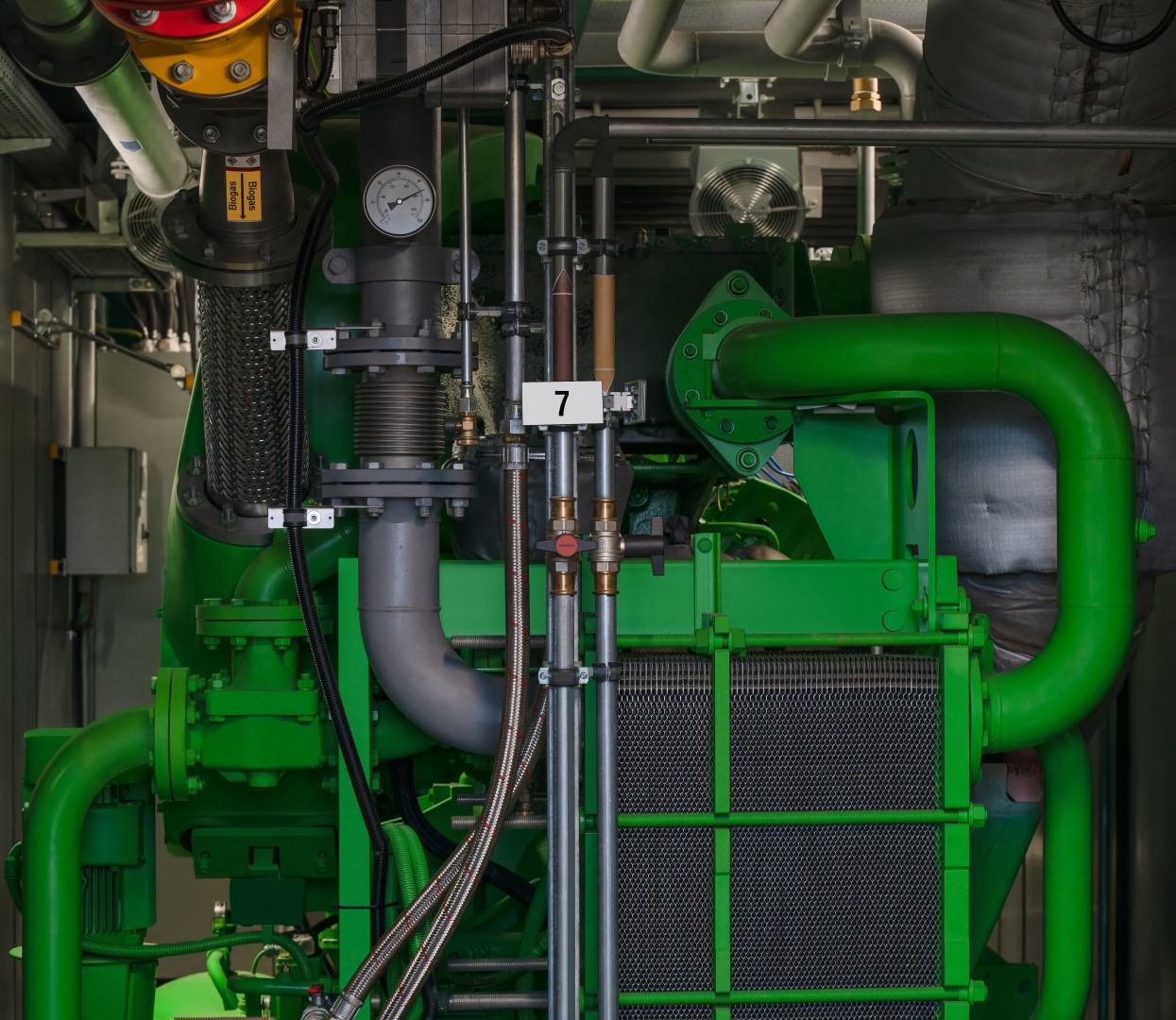
We start from the site, not from the equipment. The first step is a non-invasive check-up of the existing plant: the condition and running hours of the engine, how the digester is performing, and the data on how the site uses its heat and electricity. Only then does it make sense to compare the three routes.
From there, we can work on any of them:
On the control side, our smaller biogas units manage the digester biology and the CHP engine from a single PLC. mtmconnect, our remote monitoring platform, tracks energy performance, operating costs and CO₂ savings, and provides the data for predictive maintenance.
We have been designing and building cogeneration, trigeneration and biogas plants since 2009, with more than 100 installations completed.
Can an existing biogas CHP plant be converted to biomethane?
Yes. The digester and most of the gas pre-treatment can usually stay. The conversion adds an upgrading unit, plus either a grid connection or a way to supply the gas as vehicle fuel. The CHP engine is then retired or derated to cover the site’s own needs. Whether conversion makes sense depends on the plant’s biogas flow, its distance from the gas grid and how much heat the site uses.
Is a CHP conversion eligible for the Green Gas Support Scheme?
No. The GGSS supports new anaerobic digestion plants producing biomethane, and equipment that has already been used to produce biogas is not eligible. The government confirmed this in January 2024 and said it would consider conversions in a future biomethane policy framework. A conversion should therefore be planned on the plant’s own performance, with any future support treated as a bonus rather than the reason to invest.
What is CHP derating?
Derating means reducing the rated output of a CHP unit, or replacing it with a smaller one, so that it matches the site’s own heat and electricity demand. On a biogas plant, the gas the derated engine no longer needs goes to an upgrading unit. The engine keeps supplying heat to the digester and runs close to full load, and the surplus gas leaves the site as biomethane.
How much biogas do you need for upgrading?
There is no single threshold. Upgrading units start from around 50 Sm³/h; ours range from 50 to 1,000 Sm³/h. The cost per unit of biomethane falls as the unit gets bigger, so smaller plants often find full conversion hard to justify. For them, derating with a smaller upgrading unit, or sharing an upgrading and injection point with neighbouring sites, can change the numbers.
What heats the digester after a conversion?
Something has to replace the CHP engine’s recovered heat, because the digester needs warmth all year to keep the biology working. The usual options are:
Whether your plant is coming off RO or FiT support or simply due an engine overhaul, the first step is the same. Our non-invasive check-up looks at the engine, the digester and how your site uses its heat and electricity. You then get a clear view of which route fits, and that can include staying as you are. Book a check-up.